
Key Takeaways
- Regulatory shifts from OCR, the FTC’s BetterHelp and Monument orders, and the OARFPA action against Evoke Wellness have redefined paid search mechanics for treatment centers 2, 9, 4, 5.
- Level-of-care pages, insurance verification forms, and assessment tools sit inside the PHI perimeter, requiring server-side tags, hashed non-health identifiers, and BAAs with every vendor that touches admissions data 1, 2, 6.
- Ad copy and landing page claims covering outcomes, insurance, level of care, and credentials need dated, defensible substantiation files, since OARFPA and AMA opinion 9.6.1 now carry civil and professional exposure 5, 12.
- Allocating budget by intent segment and per-program CPA ceilings tied to net revenue per admission, while feeding the auction only qualified-call conversions, corrects the cheap-click drift that inflates cost per admission 3.
Why Paid Search Stopped Being a Creative Problem for Treatment Centers
Paid search for treatment centers used to reward whoever wrote the sharpest ad copy and bid hardest on the obvious keywords. That era is over. The operators filling beds predictably in 2025 are not winning on headlines; they are winning on instrumentation, substantiation, and media allocation that pays for admissions rather than clicks.
Three regulatory shifts forced the change. HHS Office for Civil Rights clarified in its March 2024 update that tracking data on treatment center websites can constitute protected health information depending on page context and vendor arrangements 2. The FTC finalized its order against BetterHelp banning the disclosure of consumer health data for advertising 9, then brought a parallel action against Monument for the same pattern in alcohol addiction treatment 4. A 2025 settlement with Evoke Wellness under the Opioid Addiction Recovery Fraud Prevention Act added civil penalty exposure for deceptive ad claims in the substance use disorder category 5.
Each of these changes reaches directly into the mechanics of a paid search account: which pixels fire, which vendors need a business associate agreement, which claims can appear in a headline, and which conversion events can be sent back to Google or Meta. Cost per admission is now a function of how well those mechanics are engineered, not how clever the creative sounds.
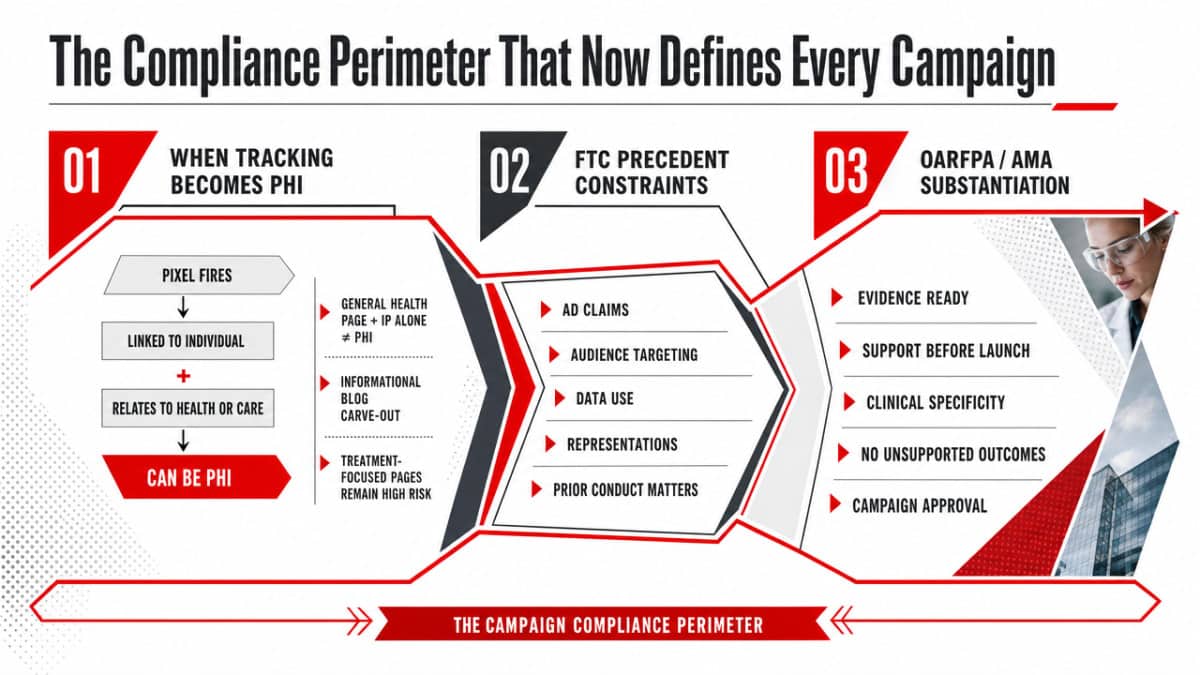
The Compliance Perimeter That Now Defines Every Campaign
When Pixel and Analytics Data Becomes PHI
The threshold question for any treatment center running paid search is whether the data flowing off its website already qualifies as protected health information the moment a pixel fires. HHS Office for Civil Rights answered that question directly: tracking data can constitute PHI when it is linked to an individual and relates to that person’s past, present, or future health or health care, even before the visitor becomes a patient 1.
The March 2024 web guidance narrowed one piece of the earlier position. OCR clarified that an IP address connected to a visit to a general health-related page is not, by itself, enough to create PHI if the visit is unrelated to that individual’s health or care 2. That carve-out matters for informational blog traffic. It does not rescue the pages that actually drive admissions.
Landing pages built around specific levels of care, insurance verification forms, assessment quizzes, symptom checkers, and appointment schedulers sit squarely inside the PHI perimeter. When a visitor reaches a page titled for opioid detox and a third-party pixel captures that URL alongside an identifier, the disclosure is the kind OCR flags as impermissible without a business associate agreement or valid authorization 1, 2. The same logic applies to authenticated patient portals, where OCR’s strictest interpretation still governs 2. The compliance question is not whether tracking exists on the site. It is which pages the tracking touches and which vendor receives the signal.
The Monument and BetterHelp Precedents Operators Cannot Ignore
Two FTC orders have set the operational ceiling for behavioral health advertising, and neither company was a HIPAA-covered entity when the conduct occurred. That is the point operators keep missing.
The BetterHelp order, finalized in July 2023, banned the company from sharing consumers’ health data for advertising and required a $7.8 million payment for consumer refunds after the platform disclosed email addresses, IP addresses, and intake questionnaire responses to Facebook, Snapchat, Criteo, and Pinterest 9. The FTC’s underlying analysis emphasized that pixel-based data flows silently transmitted sensitive information to ad platforms in a way that contradicted the company’s privacy promises, and that those promises are enforceable regardless of HIPAA status 8.
The Monument action in April 2024 followed the same pattern in the alcohol addiction treatment category. The FTC alleged that Monument disclosed users’ personal health data to Meta and Google to target ads to both current users and new prospects, and the proposed order banned sharing health data for advertising while imposing a $2.5 million civil penalty suspended based on ability to pay 4. The relief structure is what matters more than the dollar figure: a permanent bar on the data flows the advertising account was built on.
For treatment center operators, the read-through is direct. If a paid search or paid social account depends on standard event pixels firing from admissions-related pages, retargeting audiences built from site behavior, or conversion signals that describe what the user was seeking, the current stack looks a lot like the stack the FTC has already ordered dismantled twice. The enforcement pattern shows regulators are willing to strip a behavioral health advertiser of its optimization inputs entirely, then let it continue advertising only in ways that carry no health signal 9. Rebuilding tracking under that constraint before an inquiry arrives is materially cheaper than rebuilding it after.
OARFPA, AMA Truthfulness, and the Ad Copy Substantiation Line
The Opioid Addiction Recovery Fraud Prevention Act moved substance use disorder advertising into a category where deceptive claims carry civil penalty exposure, not just corrective disclosures. The FTC’s 2025 settlement with Evoke Wellness under OARFPA is the working example: the agency framed the case as a signal that it will use every tool available against deceptive claims for addiction treatment services, with OARFPA specifically enabling civil penalties and refunds for unfair or deceptive SUD marketing 5.
What that means for a search headline or a landing page hero is concrete. Outcome language, success-rate figures, insurance framing, and comparative claims all now sit inside a substantiation requirement. A statement that cannot be tied to documented evidence at the moment the ad runs is a statement the FTC can treat as deceptive, and OARFPA raises the price of being wrong.
A HIPAA-Defensible Tracking and Attribution Architecture
Server-Side Tags, Hashed Identifiers, and Conversion APIs
The tracking stack most treatment centers inherited was built for a world where a Google Ads pixel and a Meta pixel sat directly on every page, firing whatever URL, event name, and user identifier the browser could see. That architecture is exactly what the FTC described as the mechanism of harm in its pixel-tracking analysis: sensitive information moving silently from health service pages to ad platforms in ways the operator did not fully see and the visitor did not meaningfully consent to 8.
The defensible replacement moves the collection point off the browser and into a server the operator controls. A server-side tag manager receives events from the landing page, strips or hashes anything that could identify the visitor, drops any parameter that describes the health context of the visit, and only then forwards a conversion signal to Google or Meta through their conversion APIs. The ad platform learns that a conversion occurred. It does not learn which level-of-care page produced it, which insurance the visitor selected, or which assessment answers preceded the call.
Two design rules keep that architecture inside the OCR perimeter. Identifiers sent to ad platforms should be hashed and non-health, meaning a hashed phone number or email captured with consent, never a URL or event name that describes a diagnosis, substance, or level of care 1, 2. And the server-side environment itself should sit with a vendor willing to sign a business associate agreement, because the moment PHI touches that server, the vendor is handling PHI on the operator’s behalf 6.
Which PPC-Adjacent Vendors Require a BAA (and What to Do When They Refuse)
HHS defines a business associate as any entity that performs functions or activities involving the use or disclosure of PHI on behalf of a covered entity, and requires a signed BAA before that relationship can operate legally 6. In a paid search stack, that definition reaches further than most operators assume.
Call tracking vendors that record admissions calls, transcribe them, or attach caller identifiers to campaign data are handling PHI the moment the caller describes a condition or asks about a level of care. CRM and admissions platforms that ingest form submissions from level-of-care landing pages are handling PHI on intake. Server-side tag containers, form builders embedded on assessment pages, and chat vendors on treatment pages fall in the same category 6, 7. Google Ads and Meta, notably, will not sign BAAs, which is precisely why the conversion signal reaching them must be stripped of PHI before it leaves the operator’s server.
When a vendor refuses to sign a BAA, the operational answer is not to negotiate harder. It is to remove that vendor from any workflow that touches PHI, or to replace it with a competitor that will sign. The FTC’s Monument order shows what happens when health data reaches unsigned ad-platform recipients through everyday integrations: a permanent bar on the data flows the ad account depended on 4.
Call Tracking, Consent Logic, and the Unauthenticated Landing Page
Admissions calls are still the conversion event that matters, which puts call tracking at the center of the compliance perimeter rather than the edge. A dynamic number insertion script that swaps phone numbers by campaign source is fine on its own. The exposure begins when the call recording, transcript, or caller identifier is joined to the specific landing page URL and passed to an ad platform or an analytics vendor without a BAA 1, 6.
Consent logic on the landing page controls what fires and when. A HIPAA-defensible pattern loads no third-party marketing tags until the visitor takes an action that constitutes affirmative consent, and it never fires a tag whose payload describes the visitor’s health context. The FTC’s BetterHelp order treats disclosures made through pixels as enforceable regardless of whether the visitor understood them at the time, so the operator’s privacy notice and its actual tag behavior must match 9.
Unauthenticated landing pages sit in a narrower posture than authenticated portals, but OCR is explicit that treatment-related pages, appointment schedulers, and symptom or assessment tools remain inside the PHI perimeter even when the visitor is not logged in 2. The tracking rules that govern a patient portal govern the paid search landing page for medical detox in the same way.
What Paid Search Actually Influences in the Admissions Funnel
Paid search does not create demand for treatment. It intercepts demand that already exists and shapes what the searcher does next. That distinction matters because it defines which metrics honestly belong to the channel and which ones an admissions team is quietly borrowing from other sources.
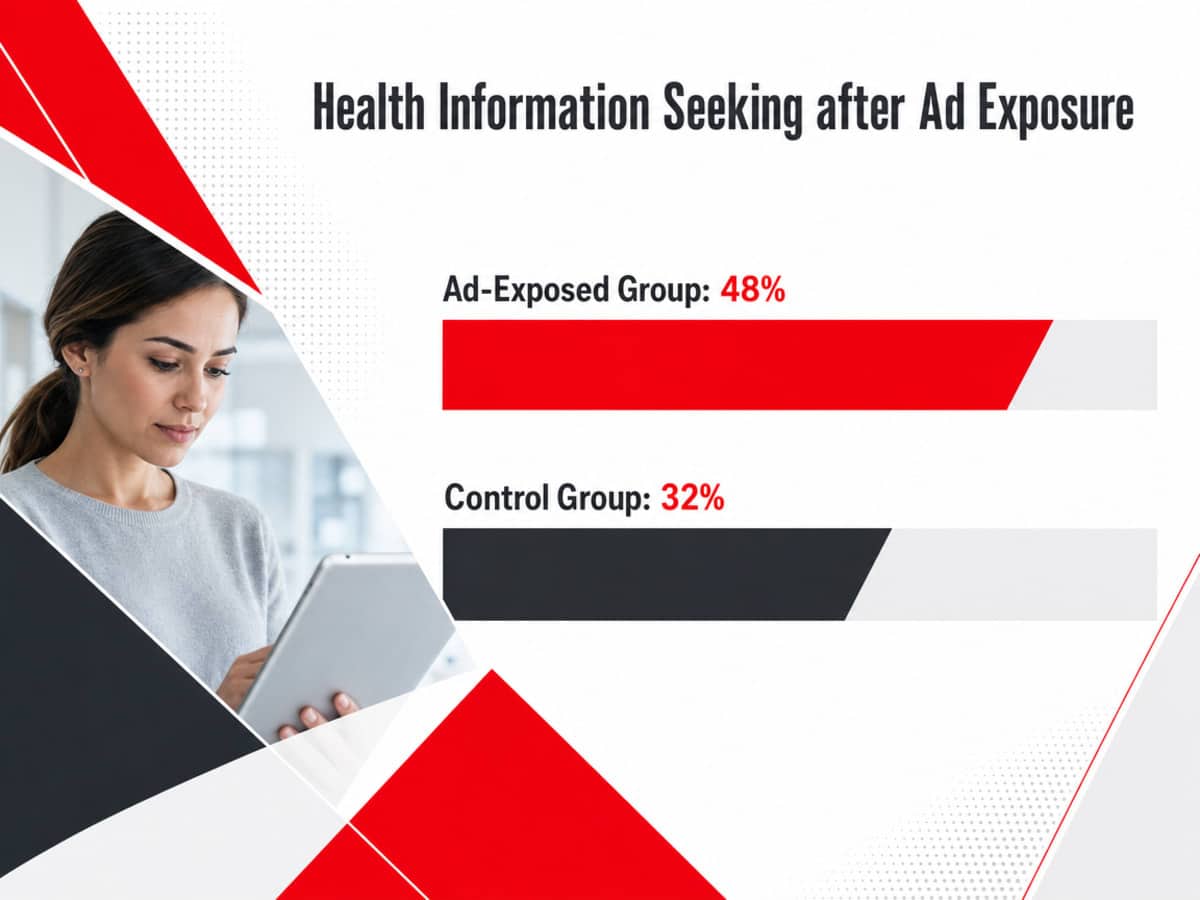
The strongest experimental evidence on that mechanism comes from a randomized-controlled trial of 794,000 participants that measured whether exposure to digital health advertisements changed subsequent health-information-seeking behavior. Among ad-exposed users, 48% went on to conduct related health-information searches, compared to 32% in the control group, a roughly 50% relative lift in information-seeking activity 3. The study measured search behavior after exposure. It did not measure treatment initiation, insurance verification, or admissions.
For a treatment center, that scope is the useful part. Paid search reliably moves a prospect from a first symptom query into deeper research: reading level-of-care pages, comparing facilities, and looking up insurance coverage. It is a top-of-funnel and mid-funnel mechanism. The bottom of the funnel, the moment an admissions call converts to a bed, is governed by call center response time, insurance verification speed, clinical fit, and family logistics, not by the ad that started the search.
Attribution models that credit paid search with the full admission overstate the channel and hide operational failures downstream. Models that credit only the last click understate it and lead to underinvestment in the queries where the funnel actually begins.
Maximize Admissions with Data-Driven Healthcare PPC
Specialized PPC strategies for treatment centers generate higher-quality admissions calls while reducing cost per acquisition, driven by sector-specific expertise and real-time analytics.
Optimize Your PPCIntent Segmentation Instead of a Keyword List
Keyword lists age badly. Intent segments do not, because they describe why the searcher typed the query, not which words happened to appear in it. For treatment center accounts, four intent segments carry almost all the admissions value, and each one demands different ad copy, a different landing page, and a different substantiation file behind whatever the ad promises.
Insurance-qualified intent. Queries that name a carrier, a plan type, or coverage language signal a prospect already past the decision to seek treatment and now filtering on payment. These searchers convert quickly when the landing page confirms accepted plans in plain terms. The claim on the ad must match the claim on the page, and both must match the current payer contracts on file, because payer language sits inside the OARFPA substantiation zone the FTC applied against Evoke Wellness 5.
Level-of-care intent. Detox, residential, PHP, and IOP queries come from prospects or referrers who have already been told, or already suspect, which level they need. Ad copy that promises a level of care must be backed by current bed availability and licensure at the facility named in the ad. Generic “we treat everything” landing pages waste this intent and invite deceptive-claim exposure when the promised program is not actually running 5.
Geo-modified intent. City, state, and “near me” queries carry logistical constraints, family visitation, transportation, licensing. Truthful geographic framing matters here; running national ads against local queries and routing to a distant facility is the pattern regulators read as misleading 12.
Family-searcher intent. Queries phrased in the third person, “help for my son,” “how to get my wife into rehab,” come from a different buyer than the patient. The conversion is a phone call from a family member, and the landing page must speak to that reader without making outcome promises about the patient it has never assessed 12.
Building the account around these four segments replaces the endless keyword expansion cycle with a smaller number of well-substantiated campaigns, each one defensible against the claim standard OARFPA and AMA 9.6.1 impose on every headline 5, 12.
Why Cheap Clicks Produce the Most Expensive Admissions
The account metrics that look best in a Google Ads dashboard are often the ones producing the worst admissions economics. Broad match keywords paired with Performance Max campaigns will reliably drop the average cost per click, because the auction is filling inventory with queries that no competing treatment center is bidding on. Those queries are cheap for a reason: they come from people researching symptoms, comparing sober-living costs, looking for job listings at rehabs, or writing school papers.
The mechanism the 794,000-participant trial documented, a lift in downstream health-information seeking after ad exposure 3, works against the operator here. Broad, low-intent impressions generate research clicks that never call. The account learns to optimize for the cheapest available conversion event, and if that event is a form fill or a page view rather than an admissions-qualified call, the algorithm accelerates spend toward whichever audience produces the most of them.
The correction is to feed the auction a narrower conversion signal. Admissions-qualified calls, verified through the call tracking layer, become the primary conversion. Broad match and Performance Max stay off until phrase and exact match campaigns built on the four intent segments have produced enough qualified-call volume to train against.

If You Run Multiple Facilities or Levels of Care: Allocating Spend by Admission Economics
The audience shifts here. Single-facility operators can skim; this section is written for owners running two or more facilities, or a single facility with distinct detox, residential, PHP, and IOP programs sharing one ad account.
The common failure pattern in multi-facility accounts is spend that follows click volume instead of admission economics. Detox queries are expensive and scarce, IOP queries are cheaper and abundant, and a shared budget with a shared conversion goal will drift toward whichever program produces the most cheap calls, regardless of whether those calls fill the beds that pay for the account. The correction is a per-program CPA ceiling expressed as a share of net revenue per admission, not a flat dollar target imported from another market.
The framework below is a planning table operators fill in with their own numbers. No CPA benchmarks are asserted because the supplied research does not contain them, and inventing them would put a substantiation exposure on the page under the same OARFPA standard the FTC applied to Evoke Wellness 5.
| Level of Care | Typical LOS | Ad Spend Share | Target CPA Ceiling (% of net revenue per admission) | Attribution Window |
|---|---|---|---|---|
| Medical Detox | [operator input] | [operator input] | [operator input] | Short (days) |
| Residential | [operator input] | [operator input] | [operator input] | Short-to-mid |
| PHP | [operator input] | [operator input] | [operator input] | Mid |
| IOP | [operator input] | [operator input] | [operator input] | Longer |
Two structural rules make the table work. Each program gets its own campaign, its own conversion action, and its own qualified-call definition inside the call tracking layer, so the auction optimizes against admissions economics that actually differ by level of care. And each facility named in an ad must be the facility that answers the call and admits the patient, because geographic and program-level bait-and-switch is the pattern AMA 9.6.1 treats as deceptive 12and the pattern regulators read as an OARFPA claim problem when the level of care promised is not the level of care delivered 5.
Landing Pages and Ad Copy That Survive Substantiation Review
Every claim on a treatment center landing page should exist in a folder somewhere, dated, attributable, and defensible. That is the working definition of substantiation the FTC applied against Evoke Wellness under OARFPA, and it is the standard the next enforcement action will apply to whichever advertiser is next in line 5.
Four claim categories draw the most exposure. Outcome and success-rate language needs a documented methodology, a defined denominator, and a date range that matches the ad flight. Insurance framing needs current payer contracts on file for every plan named. Level-of-care descriptions need matching licensure at the facility that answers the call. Clinical credentials and staff qualifications need current verification, not a bio written three years ago. AMA ethics opinion 9.6.1 treats any material omission or misleading statement as a professional violation regardless of technical accuracy, which raises the bar on comparative language and testimonial framing 12.
The landing page and the ad have to say the same thing. A headline promising residential care that lands on a page describing outpatient services is the pattern regulators read as bait-and-switch, and it invites the same civil penalty exposure OARFPA created for deceptive SUD marketing 5. Reviewing the substantiation file quarterly, not annually, keeps the account current with staffing changes, payer contract renewals, and program adjustments that would otherwise turn last quarter’s truthful ad into this quarter’s deceptive one.
Frequently Asked Questions
Is running a Meta or Google retargeting pixel on a treatment center website still allowed under HIPAA and FTC rules?
Standard client-side retargeting pixels on level-of-care pages, assessment tools, and appointment schedulers are the exact configuration the FTC dismantled in the BetterHelp and Monument orders 9, 4. OCR treats those pages as inside the PHI perimeter 2. Retargeting can continue only through server-side conversion APIs sending hashed, non-health identifiers to platforms that will never receive PHI 1, 8.
Which PPC-adjacent vendors actually need a signed BAA?
Any vendor that receives PHI while performing a function on the operator’s behalf qualifies as a business associate under HHS guidance 6. In practice that includes call tracking vendors that record or transcribe admissions calls, CRM and admissions platforms ingesting intake forms, server-side tag containers, chat tools on treatment pages, and form builders on assessment pages 6, 7. Google and Meta will not sign.
What ad copy claims trigger OARFPA or FTC exposure for addiction treatment advertisers?
Success-rate figures without documented methodology, insurance framing that outruns current payer contracts, level-of-care promises the facility is not actively running, and comparative or guarantee language top the list. The Evoke Wellness settlement shows the FTC will use OARFPA to seek civil penalties and refunds for deceptive SUD marketing 5. AMA opinion 9.6.1 adds a professional standard against any misleading statement or material omission 12.
Why do broad match and Performance Max campaigns often raise cost per admission instead of lowering it?
Both formats fill inventory with low-intent queries that reduce average cost per click while producing form fills and page views instead of admissions-qualified calls. The algorithm then optimizes toward whichever cheap conversion appears most often. Research clicks generated by broad exposure lift information-seeking behavior 3, but that behavior rarely converts to a bed. Feeding the auction only qualified-call conversions corrects the drift.
How should operators allocate PPC spend across detox, residential, PHP, and IOP?
Each program should carry its own campaign, its own conversion action, and a CPA ceiling expressed as a percentage of net revenue per admission rather than a flat dollar figure. Detox and residential tolerate higher acquisition cost because revenue per admission is higher; PHP and IOP require tighter ceilings. The facility named in the ad must be the facility that admits the caller 12, 5.
Does the Monument settlement mean treatment centers can no longer measure conversions from paid search?
No. The Monument order bans disclosure of health data for advertising, not measurement itself 4. Operators can still count admissions-qualified calls, attribute them to campaigns inside a BAA-covered call tracking layer 6, and send hashed, non-health conversion signals to ad platforms through server-side APIs 1, 8. What ends is passing URLs, event names, or identifiers that describe the visitor’s health context to Google or Meta.
References
- Use of Online Tracking Technologies by HIPAA Regulated Entities (PDF). https://www.hhs.gov/sites/default/files/use-online-tracking-technologies.pdf
- Use of Online Tracking Technologies by HIPAA Covered Entities and Business Associates. https://www.hhs.gov/hipaa/for-professionals/privacy/guidance/hipaa-online-tracking/index.html
- The effectiveness of public health advertisements to promote health: a randomized-controlled trial on 794,000 participants. https://pubmed.ncbi.nlm.nih.gov/31304306/
- Alcohol Addiction Treatment Firm Will Be Banned from Disclosing Health Data for Advertising. https://www.ftc.gov/news-events/news/press-releases/2024/04/alcohol-addiction-treatment-firm-will-be-banned-disclosing-health-data-advertising-settle-ftc
- Enforcing the Opioid Addiction Recovery Fraud Prevention Act: FTC’s settlement with Evoke Wellness. https://www.ftc.gov/business-guidance/blog/2025/06/enforcing-opioid-addiction-recovery-fraud-prevention-act-ftcs-settlement-evoke-wellness-what-it
- Business Associates. https://www.hhs.gov/hipaa/for-professionals/privacy/guidance/business-associates/index.html
- What are the HIPAA Marketing Rules?. https://www.hipaajournal.com/hipaa-marketing-rules/
- Lurking Beneath the Surface: Hidden Impacts of Pixel Tracking. https://www.ftc.gov/policy/advocacy-research/tech-at-ftc/2023/03/lurking-beneath-surface-hidden-impacts-pixel-tracking
- FTC Gives Final Approval to Order Banning BetterHelp From Sharing Consumers’ Health Data for Advertising. https://www.ftc.gov/news-events/news/press-releases/2023/07/ftc-gives-final-approval-order-banning-betterhelp-sharing-sensitive-health-data-advertising
- Marketing | HHS.gov. https://www.hhs.gov/hipaa/for-professionals/privacy/guidance/marketing/index.html
- Digital marketing and consumer health: In search of evidence. https://www.ncbi.nlm.nih.gov/pmc/articles/PMC6335781/
- 9.6.1 Advertising & Publicity – AMA policy. https://policysearch.ama-assn.org/policyfinder/detail/Advertising%20and%20publicity?uri=/AMADoc/Ethics.xml-E-9.6.1.xml
- Keep pharmaceutical promotion out of doctors’ electronic tools. https://www.ama-assn.org/practice-management/digital-health/keep-pharmaceutical-promotion-out-doctors-electronic-tools